


Effortless Kindergarten Literacy Centers: Routines, Rotations, and Word Work That Build Independence

Updated Note: This post was originally written when many teachers were using Daily 5-style rotations. Over the years, my language, thinking, and understanding have shifted, and I now believe this system is a structured ‘kindergarten literacy centers’. As teachers, we are always growing, learning, and adapting. The goal is not to follow one program perfectly, but to create predictable routines where students can practice writing, listening, phonics, phonemic awareness, word work, oral language, and early reading skills while the teacher supports students in small groups.
Setting up kindergarten literacy centers can feel overwhelming at the beginning of the year. Students are still learning routines, materials, stamina, transitions, and what it means to work independently. That is why I like to introduce centers slowly, with clear expectations, visual supports, and activities that give students meaningful practice with early literacy skills.
In my classroom, kindergarten literacy centers were never meant to replace explicit instruction. They were a structure that helped students practice skills, build independence, and stay engaged while I met with small groups. The routines matter because they protect your teaching time.
Why Kindergarten Literacy Centers Need Clear Routines
When I plan kindergarten literacy centers, I want students to practice skills that have already been introduced through explicit instruction. In kindergarten, that may include letter names and sounds, phonemic awareness, oral blending and segmenting, matching sounds to letters, building and reading CVC words, practicing high-frequency words, listening to rich language, drawing and labeling, and eventually reading decodable or familiar texts.
Before You Launch Kindergarten Literacy Centers

Before your first students step through your door, you need to have a plan for what kindergarten literacy centers you are going to have and how you will organize them. In my class, there are 6 stations. I have listed the names my students know them by and the actual activities that take place at those stations.
- Work on Writing – Writing and Encoding
- Listen To Reading – Listening, Language, and Comprehension
- Word Work 1- Alphabet and High-Frequency Word Practice
- Read To Self – Decodable and Familiar Text Practice
- Meet The Teach – Teacher-Led Small Group Instruction
- Word Work 2 – Phonics and Word-Building Practice
When kindergarten literacy stations have been introduced, students have practiced and mastered expectations and routines, and stamina is building, then these are the stations we will use for our Kindergarten Literacy Center Block. Students do not go to each station every day, though, and they do not choose which stations they attend.
This is where I differ from many ‘center’ purists. It’s not that I think choosing is a bad thing; I simply find it easier for me in my class to have students assigned to each station and offer choices as part of the station itself. Also, because of time constraints, I don’t have the time for them to visit 6 stations for 20 minutes each day, and 6 stations at 10 minutes a day doesn’t give them any longevity. So instead, students travel to 3 stations each day for 20 minutes. That’s a total of one hour of literacy station work. Of course, other literacy activities are going on throughout the day, but Literacy Centers are only one hour.
How I Set Up Kindergarten Literacy Center Rotations
When it came to figuring out a station rotation plan, I started with the basics. I knew I had six stations to work with and an hour of centers to make them fit. I decided to have students visit three of those stations on the first day of stations, and the second set of three stations on the second day of stations. That means students would visit the same stations on Monday and Wednesday, and that they would visit the second set of stations on Tuesday and Thursday.
Everyone always asks, what about Friday? What will you do on Friday? Because I have other literacy activities going on throughout the day, I don’t do literacy centers on Friday. I save that day for Science, Art, and thematic activities that take a long time. It’s also very convenient to have that extra day just in case my kindergarten literacy centers get interrupted by a snow day, assembly, or “Late Start Monday” (PLCs), which we have once a month.
If you were going to see these rotations on paper. It would look like this:
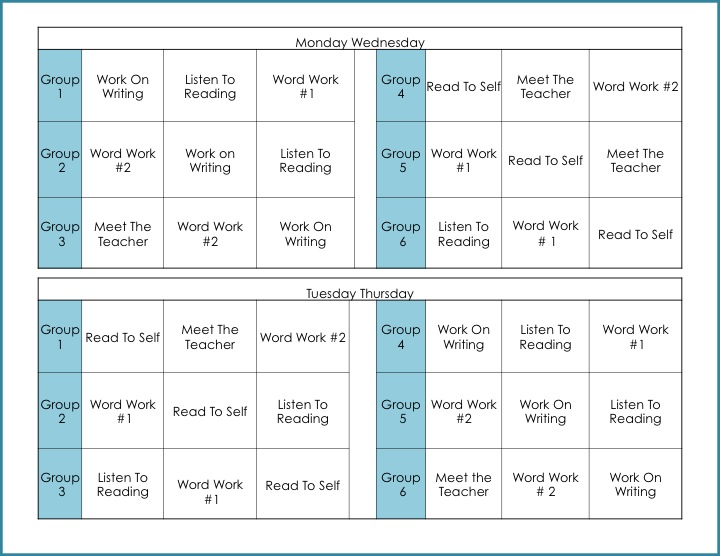
When I would first write them in my plan books, I would use this lesson plan template and attach it to my planbook plans. There’s a spot for including the standards, the activity, an area for differentiating by color, and then a space for choices. Don’t worry, I’ll explain this later. For now, here’s the template…

But this is after all stations are up and running. This is NOT a reality in the first couple of weeks of school. First of all, there will be a great number of students who have never been to school before and have never had to learn to transition from station to station or work independently. But I promise, I’ll talk about that and how you start in future posts.
Classroom Layout for Kindergarten Literacy Centers
The layout of your classroom can make or break your kindergarten literacy centers’ success. A couple of things that I have learned from working in a small classroom are:
- use every inch of space (vertical and horizontal) that you can
- be creative with space
- use space in multiple ways
- create a natural flow to avoid bottlenecks and traffic jams
I wish I could put a camera on my ceiling to show you my layout and the flow of traffic during transitioning, but I did put together this little floor plan that might help you get a visual.

Kindergarten Literacy Center Rotation Chart

When it came to figuring out a center’s rotation plan, I started with the basics. I knew I had six centers to work with and an hour of center time to make them fit. I decided to have students visit those first 3 centers on the first day of rotations and the second set of three centers the second day of centers. That means students would visit the same first centers on Monday and Wednesday, and that they would visit the second set of centers on Tuesday and Thursday.

Everyone always asks, “what about Friday?” What will you do on Friday? Because I have other literacy activities going on throughout the day, I don’t do literacy centers on Friday. I save that day for Science, Art, and thematic activities that take a long time. It’s also very convenient to have that extra day just in case my literacy centers get interrupted by a snow day, assembly or late start Monday (PLCs), which we have once a month.
I also know you’re going to ask me about the different colored name tags and whether this means that I’m already differentiating these stations. Nope! Not yet. I know very little, if anything, about these students. The colored name tags mean nothing at this point . . . but they will in a week or two.
My Kindergarten Literacy Center Stations
So here’s what the center looks like in real life before kindergarten literacy centers even get started. It’s pretty uneventful at the moment. But you will be able to see how these items and spaces transform over the year.
Writing and Encoding Center

My students call this Work On Writing
This space will eventually include transitional writing practice mats and letter-writing practice activities in the first several weeks of school. Ideally, this center is often adult-led when possible in my classroom because I’m very picky about handwriting and letter production. But when an adult volunteer or an aide is not provided during a given year, this will be an independent station that is initially used for handwriting instruction and, eventually, more extended writing practice.

There’s also a set of drawers that will be used to house activities and choices for students practicing at this center.
Listening, Language, and Comprehension

My students call this station Listen to Reading
To save space, I have my listen to reading centers in bags hanging from the wall. These bags have worked perfectly for me for many years now. In each bag there is a clipboard, a CD player, headphones, a book and a pencil bag. (If you’d like to see my tip for using cd’s in your listening center, check it out HERE.)

Now you might be thinking, “Why on earth are you using CD players for this and not Chrome Books or iPads?” Well, sometimes I do, but quite honestly, I have literally 100s of books on CD and I like the idea of students having a book in hand, turning pages, and physically manipulating written work.

After some time of just learning to use the CDs and books, students will be utilizing response sheets for what they listen to, but not in the first couple of months. If you’d like to have a set of response sheets to use in your own classroom, feel free to grab this FREEBIE by clicking on the picture below.

Alphabet and High-Frequency Word Practice

My students call this Word Work 1
In this station, students will focus on letters/high-frequency words, depending on the time of year and their level of readiness. You will see there are a lot of drawers here. Eventually, these will be filled with different kinds of items and materials that students will use to practice mapping their high-frequency words (Ball Words). The colored drawers contain Ball Word rings, games and materials. My students will know exactly what level of ball words they are on at any given time. They can grab a ring of words to practice with the materials in the white drawers or use the ball word games and materials. But that’s a couple of months down the road.
Decodable and Familiar Text Practice

Students refer to this as Read to Self
In the early weeks, this kindergarten literacy center is not about sending students off to read independently before they are ready. It is about teaching book handling, directionality, stamina, storytelling, oral language, and routines. As students learn letter-sound patterns and begin decoding, this center can include decodable texts that match skills they have already been taught, along with familiar read-alouds, picture books for retelling, and books connected to student interests.

(I’ll talk more about Sit Spots later, but for now, I can tell you that these little spots are great for getting your kids thinking about where ‘good spots’ to sit and read are in our classroom. They’re a nice scaffolding tool to train your students about making good choices.)

Here, I have my students’ boxes preloaded for when we start practicing read to self. Remember, these first weeks are for learning routines only. Eventually, these boxes will have decodable books, and students will also be able to shop for some books themselves. However, for their first book selection, I picked some books for them based on the Student Interest Inventory their parents filled out at Open House.
Teacher-Led Small-Group Instruction

Students refer to this center as Meet the Teach
This is my ‘teacher-led small group instructional area.’ I’ll talk more about this later, but for now, the first few weeks of kindergarten literacy centers will have fairly independent center activities, which I have introduced during whole group first. That way, I can still manage the room. I will ‘manage the room’ until I think they are really ready to be independent at all centers. I would rather take it slow and wait to really start my small groups until I know those groups won’t be getting interrupted every 2 minutes.
You’ll notice I don’t have a kidney table. I use just a regular small rectangular table. Most of the supplies I need for these group activities are located close at hand. It’s also where I keep my timer and the station rotation board near me. I want this to be visible for EVERYONE, and I want my students to get to the point where they can quickly look and see where they need to be.
Phonics and Word-Building Practice

This center is known to students as Word Work 2
This center will mainly focus on phonics skills and word-building activities. Students will be able to come to this station and choose what activity they would like to complete for that day. There are times when I have a ‘must complete’ activity, but generally, they have plenty of choices to keep them occupied and engaged.
Tips for Launching Kindergarten Literacy Centers Without Chaos
Now that you have seen the “how and why” of setting up the Kindergarten Literacy Centers block. You can get started on considering what activities to use in those first few weeks. Stay tuned for that post. I am going to walk you through it using my ‘Getting Started With Kindergarten Literacy Stations‘ activities and a couple of FREEBIES.

Tools That Make Literacy Centers Easier To Manage
You do not need a classroom full of fancy supplies to make kindergarten literacy centers work, but a few reusable tools can make routines, storage, and student independence much easier. These are the kinds of supplies I like because they can be used across many different centers all year long. Travel to my Amazon Storefront and click on Literacy Center Tools to see what I suggest.

Free Kindergarten Literacy Center Rotation Cards
Share This:

Marsha Moffit McGuire
Short little bio goes here. Short, sweet, and lets visitors know about your experience, expertise, etc.


Leave a Reply